

In today’s highly competitive enterprise application landscape, ERP partners are under constant pressure to deliver flawless implementations while protecting margins. As transformation initiatives accelerate, client expectations around stability, performance, and zero-defect go-lives continue to rise. Yet many partners struggle to balance delivery quality with profitability at scale.
This is where external testing emerges – not as a cost-saving tactic, but as a strategic margin lever.
The Margin Challenge Behind ERP Delivery
ERP programs are inherently complex. Multiple integrations, custom extensions, cross-functional workflows, and regulatory requirements significantly increase delivery risk. Traditional in-house testing models often fail to keep pace:
- Internal QA teams are expensive to scale and maintain, with fixed headcount, training, and tooling costs.
- Manual testing slows delivery cycles and delays revenue realization.
- Limited test coverage increases defect leakage, leading to costly post-go-live fixes and loss of stakeholder confidence.
External Testing: From Cost Center to Margin Multiplier
External testing is frequently perceived as an expense-control measure. In practice, it delivers far more value – driving efficiency, scalability, and financial flexibility.
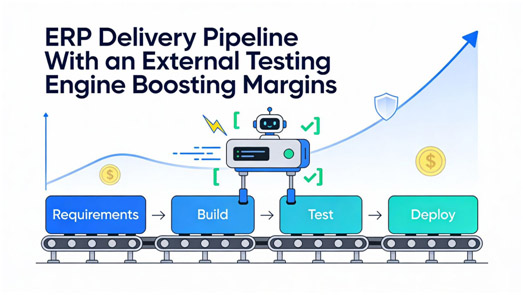
1. Converting Fixed Costs into Variable Spend
Maintaining large internal QA teams locks partners into fixed overheads. External testing transforms these into variable, project-aligned costs, improving cost control and margin predictability. Organizations leveraging specialized testing partners report 30 – 40% reductions in QA costs, directly improving gross margins.
2. Access to Specialized Expertise – On Demand
Modern ERP environments demand deep testing capabilities across integrations, performance, security, and automation. External testing providers bring:
- Specialized skills across diverse enterprise landscapes
- Cross-industry exposure and proven frameworks
- Continuous investment in advanced testing methodologies
3. Speed and Scalability Through Automation
Automation is one of the most powerful advantages external testing delivers. Well-designed automated frameworks achieve:
- Up to 40% shorter test cycles
- Significantly higher regression coverage
- Faster validation without proportional increases in effort
Reusable automation assets transform testing into a long-term capability rather than a recurring burden – improving release velocity, system stability, and customer satisfaction.
Quantifying the ROI of External Testing
The financial impact of external testing is measurable:
- 25 – 30% reduction in post-release remediation costs
- 40 – 60% faster time-to-market through automation
- Lower support overheads due to reduced defect leakage
These gains translate into predictable delivery, improved client trust, and stronger margin sustainability.
Making External Testing Work in Practice
To unlock full value, ERP partners must approach external testing strategically:
- Integrate testing early in the delivery lifecycle to reduce rework and surprises.
- Define clear KPIs such as defect escape rates, automation coverage, and cycle times.
- Adopt tiered testing models aligned to project complexity, avoiding over- or under-investment.
- Treat testing as a strategic capability, not a transactional activity.
Quality That Directly Pays Off
In a crowded ERP services market, quality is a powerful differentiator. Partners who effectively leverage external testing:
- Deliver more predictable outcomes
- Reduce delivery and warranty risk
- Free internal teams to focus on innovation
- Improve margins through optimized cost structures
Conclusion
Improving margins as an ERP partner requires a disciplined balance between delivery excellence and operational efficiency. Traditional internal testing models struggle to scale with modern enterprise demands. External testing provides a strategic alternative – reducing costs, accelerating delivery, and improving reliability in a way that directly impacts the bottom line.
External testing is not an expense to minimize. It is a strategic investment in quality, efficiency, and profitable growth.